
What Is a Chargeback (2026 Guide for E-Commerce and SaaS Teams, with real examples)
Feb 05, 2026
A chargeback is what happens when a customer asks their bank to reverse a card payment, and the bank pulls the funds back from the merchant. If you sell online, it can feel like a rewind button you didn’t press.
This chargeback guide explains what’s really going on behind the scenes in 2026, why disputes happen so often in e-commerce and SaaS, and what you can do to prevent them without turning your support team into a courtroom. Understanding these mechanics is the first step toward effective “chargeback management”.
What a chargeback is (and why banks created it)
Chargebacks were designed as a consumer protection tool. The original idea is simple: if a cardholder is charged for something they didn’t authorize, didn’t receive, or can’t resolve with the merchant, the card issuer can step in and reverse the transaction.
From a merchant’s view, maintaining a merchant account means a chargeback is more than a refund. It usually includes a chargeback fee plus other extra fees, creates manual work, and can hurt your standing with payment partners if it happens too often. If you want a plain-language definition with examples, Investopedia’s overview of how chargebacks work is a helpful reference.
Here’s the part many teams miss: a chargeback isn’t always “fraud.” A big chunk comes from confusion and friction, like:
- a customer doesn’t recognize your billing descriptors
- a subscription renews and they forgot
- shipping is late, and they go to their bank instead of support
- someone in the household made the purchase (and nobody “owns” it)
A good mental model is an emergency brake. Customers pull it when they feel stuck or unsafe. The faster you can remove that feeling, the fewer chargebacks you’ll see.
These disputes are most common in card-not-present environments like online stores.
How the chargeback process works for e-commerce and SaaS
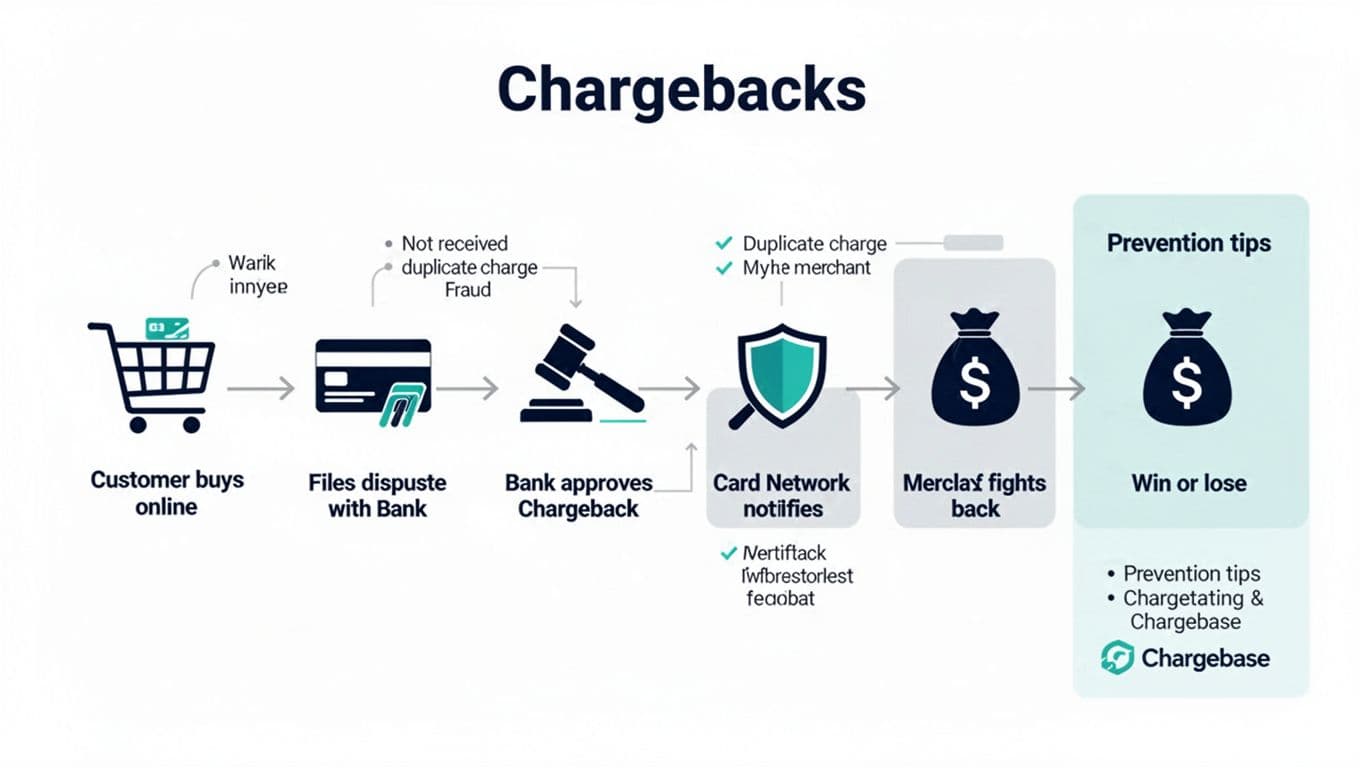
Even though Visa and Mastercard each have their own rules, the flow usually looks like this:
The customer buys. Later, they dispute the charge through their issuing bank (sometimes inside a mobile banking app). The issuing bank reviews the claim and routes it through the card network. Your payment processor passes it to you. Then you either accept the loss or respond with evidence (often called representment, the process of submitting proof). Finally, the case is decided and funds move accordingly.
Two details matter a lot in 2026:
First, timing. By the time many merchants hear about a formal chargeback, the customer has already told their issuing bank a story. Now you’re arguing after the fact, not solving the problem.
Second, standards for “compelling evidence” are stricter than most teams expect. For the official, network-level view of how disputes are processed, Mastercard publishes a merchant chargeback guide (PDF).
For SaaS companies, proving usage of digital goods often isn’t a shipping label. It’s login records, IPs, timestamps, screenshots of cancellation flows, and proof that the user accessed the service. For e-commerce, it’s tracking, delivery confirmation, customer messages, and clear product descriptions.
The most common chargeback reasons in 2026 (with real examples)
Chargeback reason codes vary, but most disputes you’ll see fall into a few buckets. What changes between e-commerce and SaaS is the “proof” a bank considers convincing.
1) Chargeback fraud (unauthorized use)
E-commerce example: A first-time buyer places a rush order for high-value items, ships to a freight forwarder, then disputes as unauthorized.
SaaS example: A stolen card starts a trial, upgrades, then the real cardholder disputes when they see the charge.
2) Friendly fraud (first-party disputes)
This is when the cardholder (or someone close to them) made the purchase, but they still dispute it.
E-commerce example: “Package not received” even though tracking shows delivered.
SaaS example: “I didn’t authorize this” after a team member used a corporate card.
3) Not received or delivery problems (e-commerce-heavy)
Example: A customer orders a gift, it arrives late, they dispute instead of waiting for support to respond. Even if you later deliver, the dispute may still proceed.
4) Not as described or quality expectations
Example: The product photos look different than the item received, or the sizing guide is unclear. Customers often use disputes when they think returns will be slow. Providing compelling evidence regarding product descriptions is vital for dispute resolution.
5) Subscription and cancellation confusion (SaaS-heavy)
Example: A user cancels inside the app but still gets billed because they canceled a workspace, not the whole account. They dispute the renewal as “canceled recurring.” Merchants may need to submit a rebuttal letter to win these specific cases.
PayPal’s merchant-friendly explanation of why chargebacks matter is worth reading if you want to see how payment platforms frame the risk.
Chargeback prevention for merchants in 2026 (what works, and where Chargebase fits)
Prevention is less about “winning disputes” and more about dispute prevention, stopping them before they become chargebacks to protect your chargeback ratio. That means reducing confusion, acting fast when a customer is upset, and using tools that give you earlier signals.
A few prevention basics still move the needle:
- Make your billing descriptor recognizable, match it to your brand and receipts.
- Put refund and cancellation terms where customers will actually see them.
- Respond fast on shipping delays, and send tracking updates that don’t require logging in.
- For SaaS, keep cancellation simple, then email a confirmation right away.
For a broader set of merchant tactics, ChargebackGurus shares practical ideas in its chargeback prevention guide.
Using dispute alerts and auto-resolution programs
Many merchants now combine prevention hygiene with network programs that can stop disputes earlier, including Ethoca alerts, Verifi’s CDRN, and Visa RDR.
Chargebase is a tool for automated chargeback management built for e-commerce and SaaS teams that utilizes AI-driven automation. It connects to your payment provider with a no-code setup (often in about 2 minutes), then helps you detect likely disputes early and prevent chargebacks by acting inside the narrow response window for revenue recovery and net dollar recovery.
Based on the platform details provided, Chargebase emphasizes:
- Fully automated handling of the chargeback cycle in a secure, compliant way
- Real-time alerts that are sent when they’re likely to help you stop a chargeback
- Performance-based pricing where you pay per alert, not a big upfront commitment
- Automation rules (10+ rules available with RDR) so you can choose when to refund automatically vs review
Here’s a simple comparison using the example pay-per-alert pricing and handling options described:
| Program | What it helps with | Example pricing model | Enrollment time (example) | Refund handling |
|---|---|---|---|---|
| Verifi and Ethoca | Pre-dispute alerts and dispute alerts (often before a chargeback) | $15-25 per alert | Up to 12 hours | Manual or auto |
| Visa RDR | Auto-resolving eligible disputes | $15 per alert | Up to 5 days | Auto-only |
If you want to understand one of these channels in more detail, see Chargebase’s explanation of how Ethoca helps prevent chargebacks.
The practical takeaway: when an alert arrives early enough, a fast refund can be cheaper than a fight, especially after you factor in fees, labor, and lost inventory or churn.
Chargebacks aren’t going away in 2026, but the best teams treat them like a product problem, not just a payments problem. Tighten the customer experience, set clear refund rules, and use early-warning alerts when speed matters. Maintaining a high win rate depends on transaction monitoring and implementing strong customer authentication at checkout. If you want fewer disputes without adding headcount, a platform like Chargebase can help e-commerce and SaaS teams catch more issues before they turn into chargebacks.
You might also want to read
Chargeback Management & Software Overview
Dec 31, 2025
Chargeback Analytics & Reporting
Jan 02, 2026
Chargeback Management & Software Overview
Jan 13, 2026
Chargeback Prevention & Fraud Reduction
Jan 26, 2026