
When to Accept a Chargeback Instead of Fighting
Mar 25, 2026
Not every dispute deserves a full defense. For many merchants, the smarter move is to accept a chargeback when the math, the evidence, and the customer story all point the same way.
That can feel counterintuitive. No one likes giving up revenue. Still, fighting every case often costs more than it returns. If you need a quick refresher on understanding chargebacks, start there. The real goal is not to win every dispute. It’s to protect margin, keep your chargeback ratio in check, and spend your team’s time where it pays off.
Why Fighting Every Chargeback Can Hurt Your Business
Representment can work when you have strong proof. Yet it breaks down fast when the evidence is thin, the customer complaint is valid, or the case looks like real fraud.
Think of it like repairing an old machine. If the fix costs more than the machine, you replace it. Chargebacks work the same way. Every case has direct losses, but it also has hidden costs. Your team has to collect order records, delivery data, login history, support messages, refund notes, and policy screenshots. Meanwhile, the dispute fee may stay on your account even if you win.
Some cases are weak from the start. A stolen card purchase without strong identity signals is hard to reverse. A duplicate charge caused by your billing system is even harder. So is a subscription dispute when the renewal terms were not clear enough.

Speed also matters. Most processors give merchants a short response window, and some platforms move very fast. This Stripe chargeback guide shows how little time you may have to act. At the same time, Ethoca’s view on when merchants should dispute chargebacks makes a similar point: the right move depends on value, proof, and the chance of a better outcome.
If the order value is smaller than the labor, fees, and odds of losing, accept the chargeback and fix the cause.
That last part matters most. Accepted losses can still teach you something. Fought losses often just burn more hours.
Clear Signs It’s Better to Accept a Chargeback
Some disputes practically answer themselves. Accepting a case does not mean the customer was right. It means your odds were poor, and your time has value.
This quick comparison helps frame the decision:
| Scenario | Better move | Why |
|---|---|---|
| Low-ticket order, weak evidence | Accept | Labor and fees can exceed the recovery |
| Merchant error, like duplicate billing | Accept | The issuer will likely side with the cardholder |
| Card-not-present fraud with little proof | Accept | Reversal odds are low |
| Customer was promised a refund already | Accept | Fighting creates extra friction and risk |
| High-value order with strong delivery and usage proof | Fight | The case may justify the effort |
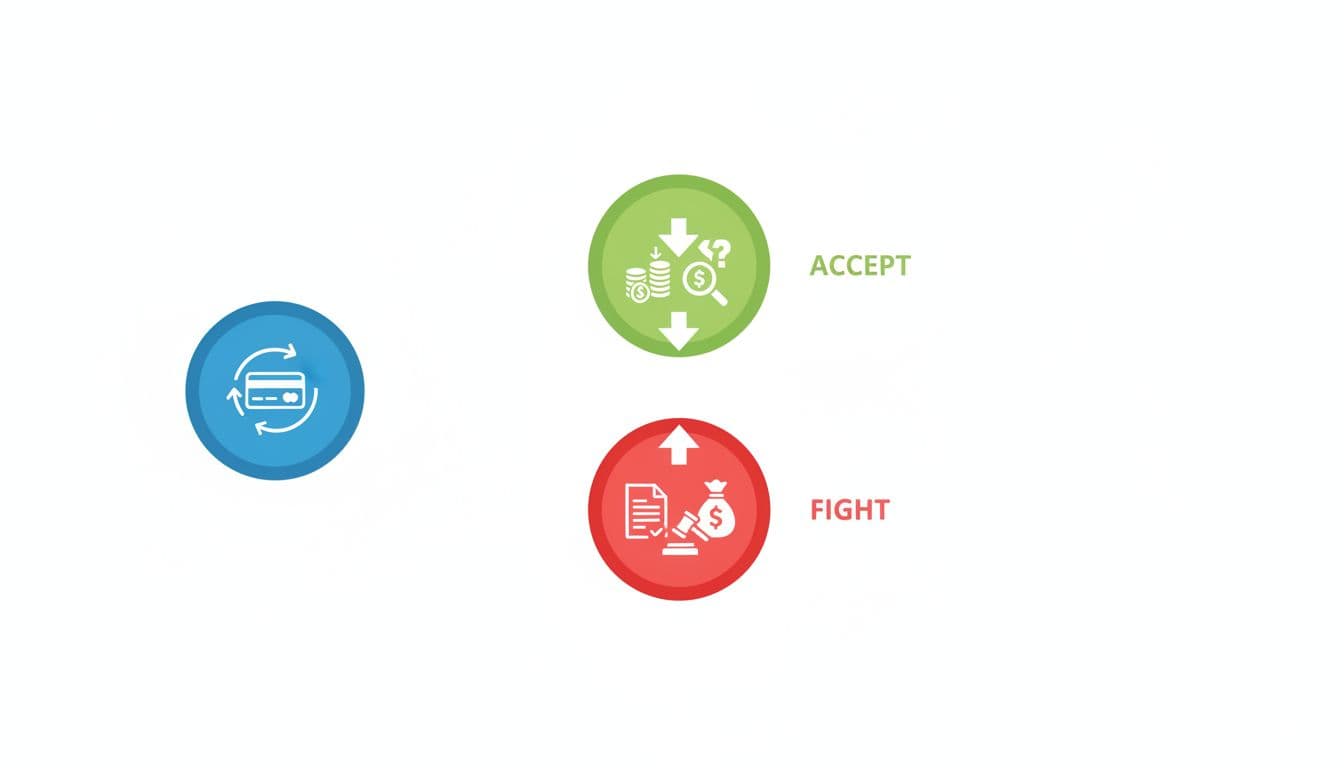
The biggest warning sign is a lack of new evidence. If you do not have proof of authorization, proof of delivery, or a clean service log now, you probably will not have it later. In that case, fighting becomes wishful thinking.
Another sign is a real service problem. Late delivery, unclear renewal terms, slow cancellation, confusing billing descriptors, or a broken product all make the bank’s choice easier. So does a support record showing the customer tried to solve the issue before filing the dispute.
A useful rule is simple: if the facts are not going to improve, don’t spend hours acting like they might. Accept the chargeback, tag the reason, and repair the upstream issue. This guide on when to accept a chargeback supports the same kind of triage. You are not giving up. You are making a cost-based decision.
Build a Faster Decision Process, Then Prevent More Disputes
Strong teams do not debate every case from scratch. They use a short playbook. First, ask whether you can prove authorization. Next, check whether you can prove delivery or service use. Then compare the order value to the staff time and dispute fee. Finally, ask whether the case points to fraud, customer confusion, or a merchant mistake.
That process gets even better when you catch disputes before they turn into formal chargebacks.

Chargebase helps here. It’s chargeback prevention software for merchants that take card and fintech payments. The platform connects to your payment provider with no code, often in just a couple of minutes, then automates much of the chargeback cycle. It works with networks such as Ethoca, Verifi CDRN, and Visa RDR, so merchants can spot pre-disputes early and act before a formal chargeback lands.
If you want a plain-language overview of how Ethoca alerts work, that guide is a solid place to start. Chargebase also gives teams more than 10 automation rules, real-time alerts, and pay-per-alert pricing, so the cost stays tied to cases where action can still help. In some programs, quick refunds at the alert stage can help keep chargeback rates low, because the dispute may never become a network chargeback.
That is often the best outcome. A fast refund on a low-value case can save the sale’s margin from turning into a larger operational loss. More importantly, it helps reduce the number of chargebacks your team has to fight at all.
The best chargeback strategy is not blind resistance. It is disciplined triage. Fight the cases you can prove. Accept the ones you cannot. Then use better alerts, better rules, and better customer experience to stop the next dispute earlier. In chargebacks, discipline usually beats pride.
You might also want to read
Chargeback Management & Software Overview
Dec 31, 2025
Chargeback Analytics & Reporting
Jan 02, 2026
Chargeback Management & Software Overview
Jan 13, 2026
Chargeback Prevention & Fraud Reduction
Jan 26, 2026