
What Counts as Compelling Evidence for Card-Not-Present Disputes
Mar 24, 2026
When a customer disputes an online payment, the sale can vanish in days. That’s why compelling evidence matters. It gives the issuer a clear reason to believe the transaction was valid, even though the card was never physically shown.
For merchants, this is no small issue. Card-not-present fraud now accounts for about 81% of payment fraud worldwide, and projected losses are expected to reach $28.1 billion in 2026. At the same time, first-party misuse keeps rising, so many card-not-present disputes come from real customers claiming a valid purchase was fraud.
What compelling evidence really means in card-not-present disputes
In simple terms, compelling evidence is proof that ties the disputed transaction to the actual cardholder. A receipt alone usually won’t do it. A shipping label alone won’t do it either. Banks want a connected story.
That story often includes identity signals, account history, delivery or usage proof, and records that show the same customer made similar purchases before without a problem. If you need a refresher on the basics, this guide on chargeback definition and reasons explains how disputes move from complaint to chargeback.
For card-not-present disputes, the strongest cases show more than one data point. Think of it like a chain. One link can snap. Several linked records hold together.
Visa’s updated framework raised the bar for fraud-related disputes, especially around friendly fraud. Instead of asking, “Did the merchant process a payment?” the better question is, “Can the merchant show this was the same buyer, using the same account, in a normal pattern?” For a network-focused view, see this Visa Compelling Evidence 3.0 guide.
The best evidence doesn’t just prove a transaction happened. It proves who made it, how they used it, and what happened next.
This matters because friendly fraud is no longer a side issue. Recent data shows it has grown sharply, and many merchants report more first-party misuse than they saw just a few years ago. So, winning more disputes starts with understanding that compelling evidence is about linkage, not paperwork for its own sake.
The evidence banks take most seriously
Some forms of proof carry more weight because they connect the buyer to the account in a way that’s hard to fake.

Here’s a quick view of what usually helps most:
| Evidence type | What it shows | Why it helps |
|---|---|---|
| Prior undisputed transactions | The same customer used the same account before | Supports repeat purchase patterns |
| Login and device records | The buyer accessed the account or service | Connects the transaction to user behavior |
| Delivery or usage proof | The order arrived, or the service was used | Counters “I never got it” claims |
| Customer communication | The buyer contacted support, updated details, or asked for changes | Shows awareness of the purchase |
Prior purchase history is often powerful. If the same account, email, device, IP range, or shipping address appears across earlier valid orders, that helps show the disputed transaction fits a normal pattern. In many fraud claims, this kind of history matters more than the disputed order by itself.
For digital products and SaaS, usage logs can be just as strong. Login dates, password resets, session history, subscription renewals, feature use, or download activity all help. If a customer says a charge was unauthorized but the same account kept logging in after the payment, that weakens the fraud claim.
Physical goods need a different angle. Delivery confirmation, address match data, order confirmation emails, and customer messages all help. Still, shipping proof works best when it sits beside other records. A package at a doorstep doesn’t prove who placed the order. The full trail does.
AVS, CVV, 3DS, and billing matches also matter, but they usually play a supporting role. They help show the transaction passed normal checks, yet they rarely win a case on their own. This overview of compelling evidence examples is helpful if you’re building a stronger representment process.
Build your evidence stack before a dispute starts
The worst time to collect evidence is after the chargeback arrives. By then, your team is racing the clock.
Strong merchants build a record from day one. That means saving checkout data, device signals, IP logs, customer emails, support tickets, refund history, delivery events, cancellation attempts, and service usage. It also means keeping these records in one place, so they’re easy to pull when a case lands.
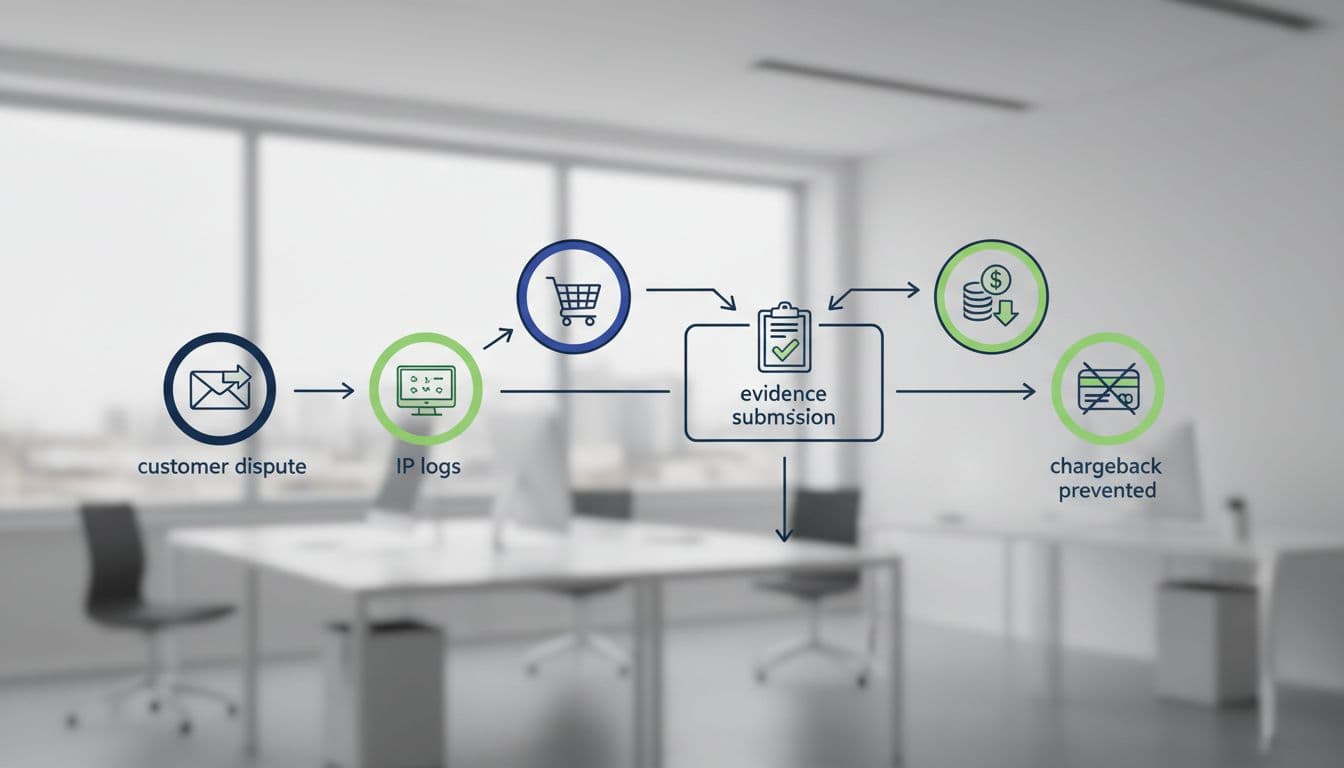
Prevention helps just as much as proof. Chargebase is a chargeback prevention software platform built for merchants that want fewer disputes to begin with. It connects to payment providers quickly, watches early-warning programs such as Ethoca, RDR, and CDRN, and sends real-time alerts when a charge is at risk. That gives teams a chance to refund, review, or stop fulfillment before some cases become full chargebacks.
Because Chargebase supports automation rules and pay-per-alert pricing, it fits companies that need faster action without adding more manual work. In other words, it can reduce the number of disputes your team has to fight later with compelling evidence. If you want to see the early-alert side of the process, this article on how Ethoca stops disputes early is a useful starting point.
Good prevention also includes the basics. Use a clear billing descriptor. Send order confirmations and renewal reminders. Make cancellation easy to find. Keep refund rules simple. These small fixes lower confusion, and confusion is often the spark behind card-not-present disputes. This guide on strategies to reduce chargeback ratios covers those habits in more detail.
Conclusion
Compelling evidence for card-not-present disputes is not a stack of random files. It’s a clear, linked record that shows the customer placed, received, or used the purchase. When merchants capture the right data early, they give themselves a real chance to win. Better yet, with strong prevention tools and clean records, many disputes never need to become a fight at all.
You might also want to read
Uncategorized
Apr 10, 2026
Uncategorized
Apr 09, 2026
Uncategorized
Apr 08, 2026
Uncategorized
Apr 07, 2026